
The Mystery of Göbekli Tepe: 11 Surprising Insights That Rewrite Early Civilization
Summary: The mystery of Göbekli Tepe has reshaped how scholars think about the rise of complex societies. This guide synthesizes discoveries, context, and debates around the site—its hunter-gatherer builders, symbolic pillars, dating, deliberate burial, and ongoing excavations—into 11 surprising, evidence-based insights.

Introduction
The mystery of Göbekli Tepe begins on a windswept hilltop in southeastern Turkey, where ringed enclosures of T-shaped limestone pillars have upended long-standing assumptions about when and how complex culture emerged. Excavated primarily since the 1990s, Göbekli Tepe predates Stonehenge by millennia and appears to have been built by largely mobile hunter-gatherers—people once assumed too dispersed to organize major construction projects. If true, this site suggests that shared beliefs and ritual gatherings may have catalyzed social complexity well before settled farming became the norm.
This article is part of our evolving knowledge base. For related topics in archaeology and human origins, browse the Arcavon Articles library.
Discovery and Setting
Although noted by survey teams in the 1960s, Göbekli Tepe’s significance wasn’t fully recognized until renewed work began in the 1990s under archaeologist Klaus Schmidt. The site sits in Şanlıurfa Province, commanding views over surrounding plains. Its positioning implies deliberate selection: the hilltop both isolates the space for ceremony and makes the monumental pillars visible from afar, amplifying any gathering’s social and symbolic impact. UNESCO added Göbekli Tepe to the World Heritage List in 2018, acknowledging its outstanding universal value and ensuring safeguards for research and preservation.
Why the Mystery of Göbekli Tepe Matters
For decades, a prevalent model suggested that agriculture came first, producing stable villages; only then, as surplus grew, did organized religion, division of labor, and monumental architecture appear. Göbekli Tepe flips that script. Here, monumental stonework emerges among groups that appear to have been pre-agricultural. The site therefore provides a test case for a different sequence: shared ritual and coordination may have encouraged people to convene regularly, which in turn could have supported experimentation with cultivation and domestication. In this way, the mystery of Göbekli Tepe pressures historians and archaeologists to reconsider the origins of civilization itself.
11 Surprising Insights
While research is ongoing, the following points summarize key takeaways from current scholarship and field reports. Each insight highlights why the mystery of Göbekli Tepe remains so compelling.
- Built by hunter-gatherers: Evidence suggests the builders were not fully sedentary. The site’s scale shows that highly coordinated projects were possible without permanent towns.
- No domestic structures: Excavations have revealed ritual enclosures rather than houses, storage rooms, or hearth clusters typical of villages. This supports the interpretation of a ceremonial, not residential, center.
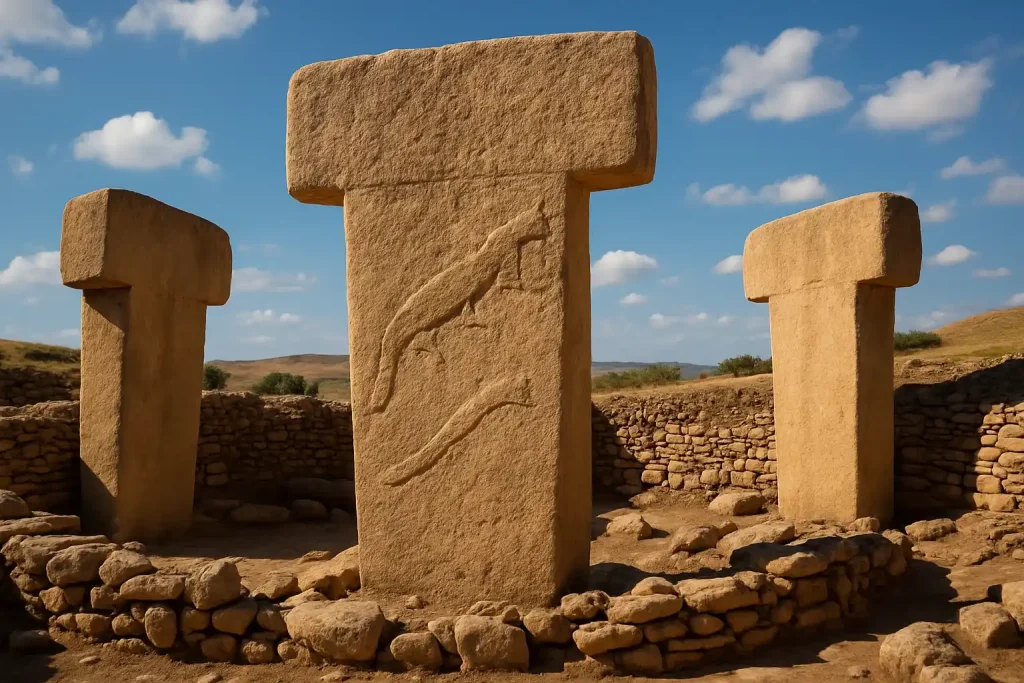
- Monumental T-shaped pillars: Some pillars exceed several meters in height and weigh many tons, implying organized labor, quarrying know-how, and shared technical knowledge.
- Rich symbolic program: Low- and high-relief carvings of animals and abstract motifs fill the site. The repertoire points to complex storytelling, myth, or ritual communication.
- Ritual gathering hub: The ringed architecture would have focused attention and sound, helping coordinated ceremonies that reinforced group identity.
- Proto-writing? A minority of researchers speculate that repeated symbols could represent early mnemonic systems. This is debated and remains unproven.
- Deep antiquity: Radiocarbon dates place early phases in the 10th millennium BCE, older than many previously known monumental sites.
- Deliberate burial: Portions were intentionally backfilled in antiquity, preserving layers and complicating interpretations of why activities ceased.
- Regional context: Nearby sites (e.g., Karahan Tepe) suggest a broader cultural milieu with related architectural and symbolic traditions.
- Generated new models of social change: Göbekli Tepe supports a model in which ritual cooperation—rather than farming alone—can spark complex organization.
- Global significance: Its recognition by UNESCO and coverage by leading science outlets underline how the site reframes narratives about early civilization.
Symbols, Art, and Possible Meanings
The carved bestiary includes foxes, snakes, boars, birds, and more—a vivid menagerie likely meaningful to the builders. Some pillars display abstract signs and stylized human features, including belt-like motifs and hands on the broad faces of T-shapes, suggesting anthropomorphic readings. Scholars debate whether the enclosures functioned as mythic “scenes,” seasonal gathering spaces, or initiatory settings. A noted example—often called the “Vulture Stone” (Pillar 43)—has been interpreted by some as referencing celestial phenomena or even a distant comet event. Such proposals are intriguing but remain contested; rigorous tests of astronomical alignment and symbol decoding are ongoing.
Regardless of specific readings, the symbolic density at Göbekli Tepe shows that groups with limited material infrastructure can still sustain rich intangible cultures—shared stories, rituals, and identities powerful enough to mobilize many hands toward a common, monumental goal.
How Old Is Göbekli Tepe?
Radiocarbon dates point to construction and use in the 10th–9th millennia BCE (often cited around the 9600–8000 BCE window for early phases). This timeframe pushes organized ritual architecture well before many classic markers of the Neolithic, adding depth to the mystery of Göbekli Tepe. The dates come from organic materials in stratified contexts; however, as with any open-air site, there is interpretive complexity. New samples and refined models may continue to adjust the chronology of activity, construction episodes, and the timing of the site’s eventual infilling.
The Puzzle of Deliberate Burial
One of the most striking features is the intentional backfilling of enclosures. Rather than simple abandonment, the builders (or later groups) seem to have “closed” the spaces with debris, stone fragments, and soil. Why? Theories include ritual decommissioning, shifts in belief, social reorganization, environmental change, or redirection of labor to new sacred sites. Whatever the motive, deliberate burial complicates the archaeological picture while simultaneously preserving delicate carvings that might otherwise have eroded away.
Debates and Controversies
As a singular site that challenges familiar sequences of cultural development, Göbekli Tepe naturally attracts competing interpretations. A mainstream view holds that local hunter-gatherers, through periodic congregation, achieved a scale of labor coordination and symbolic expression previously underestimated. Alternative proposals point to lost knowledge systems or far-reaching astronomical functions. A handful of researchers have even suggested links to catastrophic events in deep prehistory. Healthy debate is normal, but the most robust interpretations will always anchor themselves in replicable evidence: dated contexts, architectural patterns, tool marks, and regional comparisons. For readers, the key is to differentiate between cautious inference and speculation.
Ongoing Excavations and Related Sites
Only a fraction—often estimated in the single digits—of Göbekli Tepe has been excavated. As work expands, researchers expect to clarify building sequences, ritual practices, and the chronology of infilling and reuse. Meanwhile, discoveries at other locales such as Karahan Tepe suggest that Göbekli Tepe belongs to a wider constellation of early ceremonial sites in the region. Each new trench therefore informs not just one hilltop, but an entire cultural landscape, deepening the mystery of Göbekli Tepe and its role in the transition from foraging to farming.
Responsible Tourism and Preservation
UNESCO World Heritage status (2018) both celebrates and protects Göbekli Tepe. Visitors can support ongoing research by following site guidelines, minimizing physical impact, and engaging with curated museum exhibits that contextualize the pillars and carvings. The goal is to balance public access with conservation so that the stories embedded in stone remain legible for future generations. Responsible visitation also means critical engagement—reading museum labels, comparing hypotheses, and understanding what we know versus what remains uncertain.
FAQs
Is Göbekli Tepe really the world’s oldest temple? It is often described as the oldest known monumental ritual complex. “Temple” is a shorthand; scholars debate exact terminology, but the site’s antiquity and ritual focus are clear.
Who built Göbekli Tepe? Current evidence points to hunter-gatherer communities who gathered periodically to quarry stone, carve pillars, and perform ceremonies, likely drawing on shared myths and symbols.
What do the carvings mean? Interpretations range from mythic storytelling to seasonal or cosmological references. Some readings are speculative; researchers continue testing alignments and symbol patterns.
Why was it buried? The deliberate backfilling remains an open question. Hypotheses include ritual closure, social change, or shifting sacred landscapes; the debate is active.
How much has been excavated? Often cited estimates suggest a small percentage of the overall site. As more areas are studied, timelines and interpretations may evolve.
Conclusion & Further Reading
The mystery of Göbekli Tepe is less a single riddle than a living research program. Each season adds pieces: new carvings, refined dates, better maps of enclosure sequences, and clearer ties to neighboring sites. Whether one emphasizes ritual cooperation, symbolic communication, or astronomical knowledge, Göbekli Tepe compels us to widen our models of how complex societies form. In doing so, it turns a remote hill of stone into a global touchstone—reminding us that culture, long before cities, had the power to gather people, focus their efforts, and leave stories carved into rock.
For more deep dives into archaeology, human origins, and big-picture history, explore the Arcavon Articles library.
References
- UNESCO World Heritage Centre — Göbekli Tepe
- National Geographic — Göbekli Tepe: The World’s First Temple?
- Schmidt, K. (2010). Göbekli Tepe – the Stone Age Sanctuaries. Current Anthropology, 52(S4), S272–S305.
- Sweatman, M. B., & Tsikritsis, D. (2017). Decoding Göbekli Tepe with Archaeoastronomy. Mediterranean Archaeology and Archaeometry.