
The Voynich Manuscript: An Enduring Enigma
Introduction to the Voynich Manuscript
The Voynich Manuscript is often described as the world’s most mysterious book, an enigma that continues to fascinate historians, linguists, cryptographers, and curious readers alike. Discovered in the early twentieth century but believed to have been written during the fifteenth century, the manuscript is filled with elaborate illustrations of unknown plants, astronomical diagrams, and naked human figures bathing in strange contraptions. What makes it truly extraordinary, however, is its script: an undeciphered language that no one has been able to translate with certainty. This puzzling combination of cryptic writing and bizarre imagery has secured the Voynich Manuscript a unique place in history as one of the most enduring unsolved mysteries
[Tiltman, 1967];
[Ferrara, 2014].
From the moment it surfaced in 1912, the Voynich Manuscript has been a subject of intense study. Cryptographers from World War I and II, including some of the most brilliant codebreakers, dedicated countless hours to unraveling its meaning, but the book resisted all their efforts. Even with modern artificial intelligence and advanced computer analysis, researchers have only scratched the surface. Some argue it is a hoax, others believe it contains lost scientific or medical knowledge, while still others see it as a coded spiritual text. Regardless of interpretation, the manuscript remains one of the rare artifacts that blurs the line between genuine scholarship and myth
[Stolfi et al., 2020];
[Zandbergen, 2015].
The intrigue surrounding the Voynich Manuscript is not merely academic. It speaks to humanity’s deep fascination with the unknown and the limits of our ability to decode the past. Its existence raises fundamental questions: Can every text be deciphered? Is human knowledge bound to encounter permanent mysteries? For many, the manuscript embodies the thrill of intellectual pursuit—an endless challenge that reminds us of the complexity of history and the resilience of human imagination
[Gordon Rugg, 2004].
In the following sections, we will explore its discovery, physical characteristics, scientific studies, and cultural impact, offering a comprehensive look into why the Voynich Manuscript continues to captivate the world. On our site, you can also explore other enigmatic stories in the Mysteries & History section.
Discovery and Historical Background
The modern history of the Voynich Manuscript begins in 1912, when Polish book dealer Wilfrid Voynich purchased it from the Jesuit College of Villa Mondragone, near Rome. The mysterious volume, bound in vellum and filled with undeciphered text and strange illustrations, immediately caught his attention. Voynich believed he had stumbled upon a priceless document that could shed light on medieval science or secret knowledge hidden for centuries. From that moment, the book carried his name and gained worldwide notoriety.
Although Voynich was the first to publicize the manuscript, evidence suggests its history reaches back much further. Carbon dating performed in the early 2000s revealed that the vellum pages were produced in the early 15th century (1404–1438). Ownership records, including a 17th-century letter from Johannes Marcus Marci to the renowned scholar Athanasius Kircher, confirm that the manuscript circulated among European intellectuals long before Voynich’s discovery. Some historians speculate that it might have been part of Emperor Rudolf II’s collection in Prague, who reportedly purchased it for a substantial sum, believing it was written by the English polymath Roger Bacon
[Reddy & Kennedy, 2016];
[Greene, 2012].
Despite these fragments of evidence, the manuscript’s origin remains uncertain. Was it a practical medical or botanical text? A coded scientific treatise? Or perhaps an elaborate hoax meant to fool wealthy collectors? Each theory has added to the allure of the Voynich Manuscript, but none has been universally accepted. Voynich himself spent years trying to decipher the script, convinced that solving the puzzle would reveal hidden wisdom. Unfortunately, his efforts—and those of many scholars after him—led only to frustration and deeper mystery
[Kraus, 2006].
The historical background of the manuscript highlights its enduring ambiguity: while its journey through libraries and collectors can be traced, the identity of the author and purpose remain unknown, keeping it a subject of fascination century after century
[Zandbergen, 2015].
Physical Characteristics of the Voynich Manuscript
The Voynich Manuscript is not just intriguing for its mystery, but also for its unusual and detailed physical form. Containing 240 vellum pages, though some are missing, the manuscript appears to be divided into distinct sections based on content. The text is written in an unknown script that flows smoothly from left to right, resembling a natural language with consistent grammar and structure. Despite over a century of study, no one has succeeded in linking this script to any known language, adding to the book’s aura of enigma
[Greenberg, 2023].
The manuscript’s script—often called “Voynichese”—consists of unique symbols unlike those found in European, Asian, or Middle Eastern languages. Linguistic patterns suggest it was written with deliberate rules, but whether it represents a cipher, a constructed language, or a lost natural language remains unresolved. Its even spacing, repeated letter groups, and word frequency patterns mirror those of natural languages, convincing many that it is not random gibberish
[Stolfi et al., 2020];
[Duchêne et al., 2019].
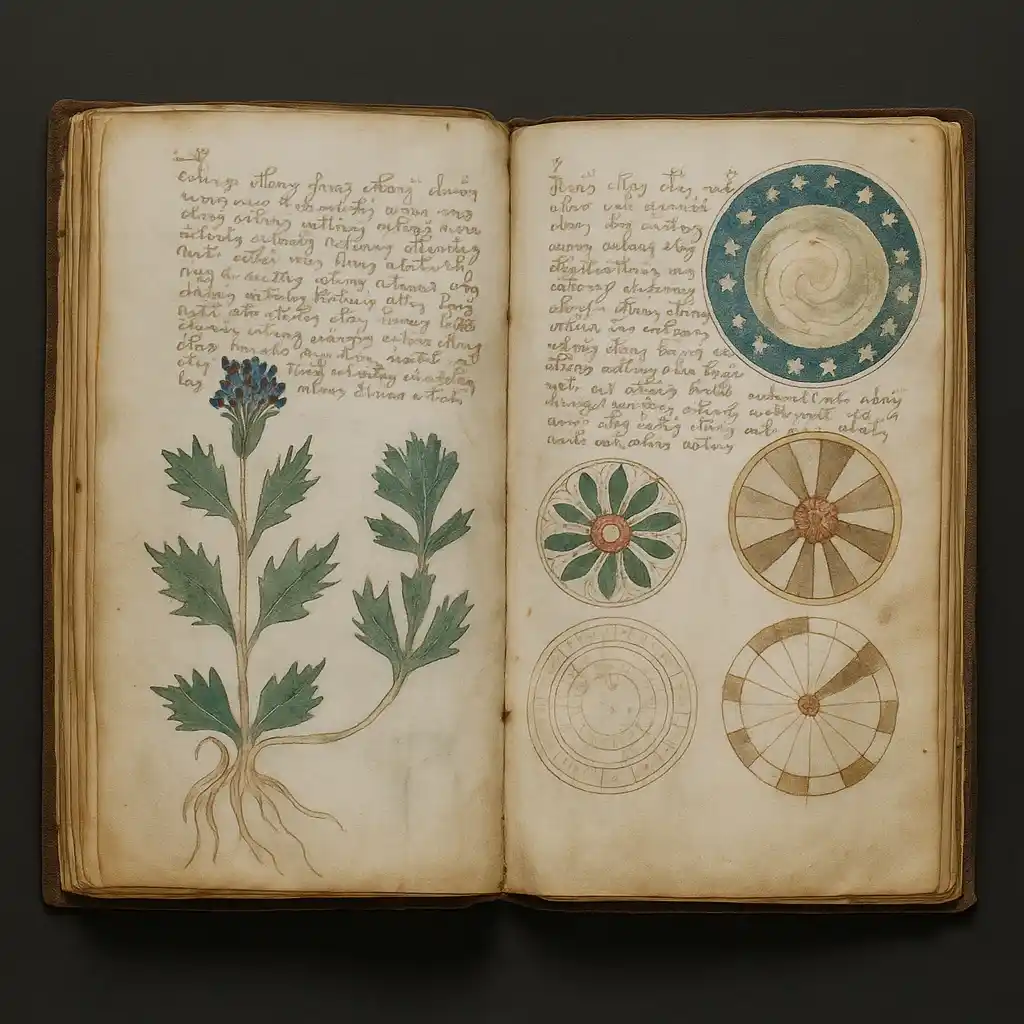
Accompanying the text are hundreds of illustrations that make the Voynich Manuscript visually captivating. These images fall into categories:
- Botanical drawings: plants that do not correspond to any known species, combining familiar elements like leaves and roots into entirely new hybrids.
- Astronomical and cosmological diagrams: depictions of stars, zodiac signs, and circular charts suggesting links to astrology or alchemy.
- Biological imagery: strange human figures, often naked women, interacting with tubes, pools, and organic systems, sparking theories about medieval medicine or fertility rituals.
- Pharmaceutical and recipe sections: drawings of jars, herbs, and text blocks resembling instructions or catalogs
[Kepler et al., 2023].
Though the drawings appear crude compared to Renaissance manuscripts, they display a consistent artistic style suggesting a single illustrator or small team. The vellum pages are high quality, and careful preparation implies the manuscript was a costly project rather than a casual sketchbook
[Fagin Davis & Henig, 2019];
[Rogers, 2016].
The physical composition of the Voynich Manuscript emphasizes it was created with purpose and effort. Whether a serious document, a coded treatise, or a brilliant hoax, its combination of undeciphered script and bizarre imagery continues to puzzle and inspire anyone who examines it
[Zandbergen, 2015].
Theories About Its Language and Meaning
The undeciphered script of the Voynich Manuscript is perhaps its most enduring puzzle. Over the past century, scholars, linguists, and codebreakers have proposed numerous theories about what the text might mean. Some believe it encodes forgotten scientific knowledge, while others argue it is an elaborate hoax designed to mislead. Regardless of interpretation, the debate over its meaning is central to its mystique
[Tiltman, 1967].
One popular theory is that the manuscript represents a ciphered text, possibly intended to hide sensitive information from prying eyes. Renaissance Europe was a time of political intrigue and secret knowledge, making the use of codes common. Cryptographers such as William Friedman, who helped break Japan’s wartime codes, spent years analyzing the Voynich text. He concluded that while the manuscript followed some linguistic rules, it did not resemble any known language. Some modern computer algorithms have suggested possible connections to Hebrew or Romance languages, but none have provided a conclusive translation.
Another school of thought suggests the manuscript was written in a constructed language, similar to an early version of Esperanto or Tolkien’s Elvish tongues. Supporters of this theory argue that the consistency of word structure indicates an artificial but systematic design. Alternatively, it could be a record of a lost natural language, one that has no surviving relatives in today’s world. If true, this would make the manuscript an unparalleled linguistic discovery
[Bowern & Lindemann, 2021].
Skeptics claim the Voynich Manuscript is a hoax, possibly created to impress or deceive a wealthy patron like Emperor Rudolf II. In this view, the script is meaningless, and the strange illustrations were intended to mimic the look of a scientific or alchemical treatise. While this theory cannot be ruled out, the statistical patterns within the text—such as word frequency and syntax-like structures—suggest a level of complexity that would be extremely difficult to fake.
Theories about the Voynich Manuscript’s meaning reflect not only the difficulty of its script but also the human desire to uncover secrets. Whether it holds genuine knowledge or is a masterful ruse, the uncertainty surrounding its language is what fuels endless fascination and ongoing research
[The Art Newspaper, 2025].
Modern Scientific Studies
In the last few decades, scientists have applied advanced tools and interdisciplinary methods to probe the mysteries of the Voynich Manuscript. These modern studies have yielded important insights into its age, material composition, and possible linguistic structure, even though the core of its meaning remains elusive. For more explorations into unexplained artifacts, visit our Articles & Insights section.
Radiocarbon Dating and Material Analysis
In 2009, a team at the University of Arizona performed radiocarbon dating on the vellum pages of the manuscript. The results showed that the parchment was produced between 1404 and 1438, placing the manuscript firmly in the early 15th century. This ruled out theories that it was a 16th- or 17th-century forgery. Additionally, ink analysis confirmed that the pigments used were consistent with medieval Europe, further supporting the manuscript’s authenticity as a product of its time
[University of Arizona, 2009];
[Wikipedia];
Computational Linguistics and AI
With the rise of artificial intelligence, researchers have turned to machine learning to test possible linguistic patterns. Some AI models suggested links between Voynichese and languages like Hebrew, Turkish, or Nahuatl, but these findings remain controversial. Critics argue that algorithms can “find” patterns even in random data. Still, computational methods have revealed consistent word distributions and grammatical-like structures, lending weight to the idea that the text encodes a genuine language
[Stolfi et al., 2020];
[Cipher Mysteries, 2025].
Biological and Botanical Studies
Scholars have also analyzed the manuscript’s illustrations. Some plant drawings faintly resemble species known in Europe and Asia, but others remain unidentifiable. A few researchers proposed that they depict composite or imaginary plants, combining traits of several species. Astronomical diagrams and zodiac imagery suggest astrological or medical applications, while the biological drawings of women in baths may point toward medieval fertility or healing practices
[Arsoy & Campbell, 2021];
Despite these advances, the manuscript’s meaning remains undeciphered. Modern tools have confirmed its authenticity, ruled out certain hoax theories, and highlighted its structured complexity. Yet the text continues to resist translation, leaving the Voynich Manuscript one of the greatest unsolved puzzles of science and history
[Greene, 2012];
Cultural Impact and Popular Fascination
The Voynich Manuscript is not only a subject of academic study but also a cultural phenomenon that has captured the imagination of people around the world. Its mysterious script, bizarre illustrations, and enduring secrecy have inspired writers, filmmakers, artists, and even conspiracy theorists. Beyond scholarship, it has become a symbol of humanity’s fascination with the unknown.
Since its rediscovery, the manuscript has been referenced in countless works of fiction. Novels such as “The Book of Secrets” by David Harley and Umberto Eco’s “Foucault’s Pendulum” draw inspiration from its cryptic aura. In film and television, it frequently appears as a symbol of hidden knowledge or an unsolvable puzzle. Documentaries produced by the BBC, National Geographic, and the History Channel have brought the manuscript to mainstream audiences, blending scholarly research with speculation about its purpose
[The Art Newspaper, 2025].
The digital age has given the Voynich Manuscript new life. After Yale University’s Beinecke Rare Book & Manuscript Library digitized it and made it publicly available online, thousands of amateur researchers worldwide began analyzing its pages. Online forums and communities dedicated to decoding the script emerged, where enthusiasts propose everything from alien languages to encoded medical recipes. While most theories remain speculative, they demonstrate how the manuscript continues to spark curiosity far beyond academic circles
[Reddit, 2025].
At its core, the fascination with the Voynich Manuscript reflects our collective yearning to solve mysteries. It embodies the idea that some truths may forever remain out of reach, yet still inspire endless exploration. For educators, it has become a teaching tool about critical thinking, cryptography, and the scientific process. For the public, it serves as a reminder that history still holds secrets waiting to be discovered.
The manuscript’s cultural impact ensures that, whether or not it is ever fully deciphered, its influence will endure. As both a historical artifact and a cultural symbol, the Voynich Manuscript bridges the gap between scholarship and imagination, continuing to intrigue generations.
Conclusion
The Voynich Manuscript remains one of the most enduring mysteries in human history. Despite over a century of scholarly effort, its script continues to resist translation, its illustrations remain open to interpretation, and its true origin is still unknown. What we do know—from carbon dating and material analysis—is that it is an authentic artifact of the early fifteenth century, crafted with remarkable care and purpose. Whether it represents a lost language, a coded treatise, or an elaborate hoax, its complexity makes it far more than a simple curiosity;
[The Art Newspaper, 2025].
What truly sets the Voynich Manuscript apart is not only the enigma it presents but the questions it raises. It forces us to confront the limits of our knowledge: can every code be broken, or do some secrets remain beyond human comprehension? The manuscript serves as a mirror of human curiosity, a reminder that the pursuit of knowledge is often as meaningful as the discovery itself
[Rare Book Hub, 1999].
Culturally, the manuscript has transcended academia, inspiring writers, filmmakers, and countless enthusiasts across the globe. In this sense, its unsolved nature is its greatest gift—it continues to provoke imagination, invite speculation, and fuel intellectual adventure.
Ultimately, the Voynich Manuscript stands as both a historical treasure and a timeless riddle. It invites us to keep searching, keep questioning, and accept that some mysteries endure not to be solved, but to remind us of the vastness of human creativity and the endless depths of history
[Voynich Ninja Symposium, 2022].
You can find more on our Articles section.