
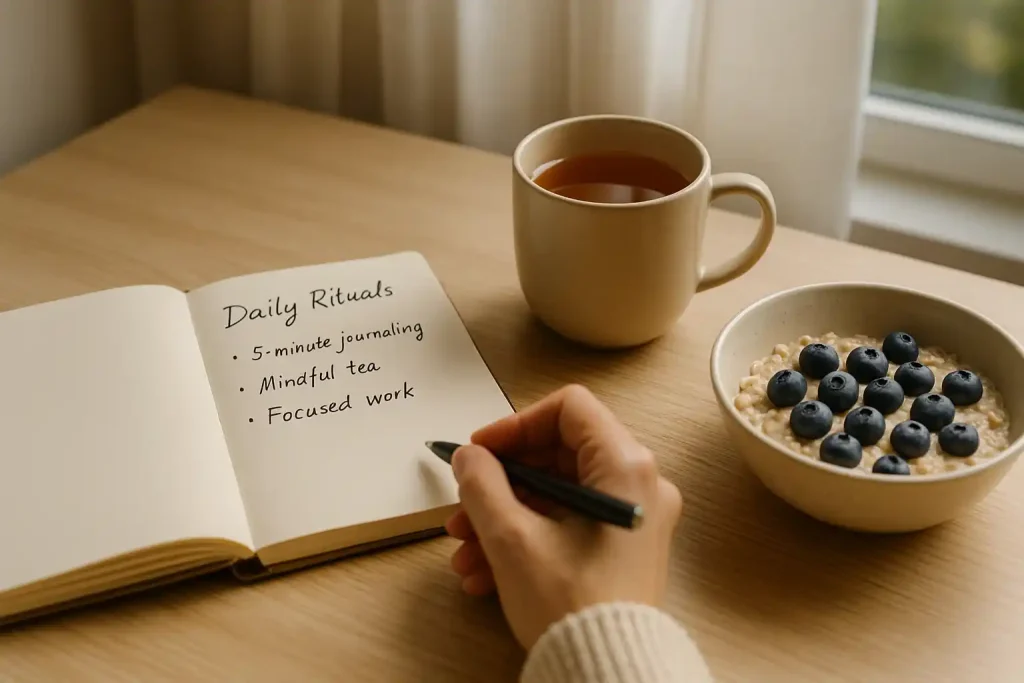
The Science of Daily Rituals: 10 Powerful Practices to Boost Well-Being
Summary: The science of daily rituals shows how small, intentional practices—brief journaling, mindful beverages, focused work windows, and evening reviews—reduce stress, sharpen attention, and improve resilience. This long-form guide reviews the neuroscience, ten evidence-based rituals, step-by-step setup, common pitfalls, and a practical 30-day plan so you can adopt rituals that stick.

What are daily rituals?
Daily rituals are repeatable, intentional actions performed with meaning. Unlike purely mechanical routines, rituals carry symbolic weight: they mark transitions, signal intention, and create predictable structure that the brain recognizes and rewards. The science of daily rituals combines cognitive psychology, neuroscience, and behavioral science to explain why these small acts often produce outsized benefits in mood, performance, and social cohesion.
Rituals can be secular (a set of steps before starting work), spiritual (a meditation or prayer), or social (a nightly family check-in). The common thread is consistency plus meaning: over time, rituals lower friction to action and provide emotional scaffolding during uncertainty.
Neuroscience behind rituals
Habit formation and ritualization involve overlapping brain systems. Repetition engages the basal ganglia, automating behavior and freeing up the prefrontal cortex for creative tasks. Ritual meaning recruits prefrontal networks tied to self-related processing and value, which increases subjective reward signals and aids persistence.
Emotion regulation
Rituals reduce amygdala hyperactivity in stressful moments by providing predictable structure. Studies show ritualized breathing and short contemplative actions lower cortisol levels and subjective anxiety—effects measurable in lab settings.
Memory and consolidation
Rituals often include reflective elements (journaling, gratitude) that bolster memory consolidation for positive experiences, improving resilience and mood over time. The intentional review of progress also establishes corrective learning loops that build skill faster than unfocused repetition.
Rituals and identity
Small rituals with explicit meaning reinforce identity—“I am someone who reflects for five minutes each morning”—which increases adherence. The identity signal adds motivation when instrumental incentives wear off.
Benefits: mental, physical, social
The evidence around the science of daily rituals suggests measurable benefits across domains:
- Mental health: Reduced anxiety, improved mood regulation, and lower rumination.
- Cognitive performance: Better sustained attention, reduced mind-wandering, and more consistent productivity.
- Physical well-being: Improved sleep when evening rituals are in place; lower physiological stress markers.
- Social cohesion: Family or team rituals improve trust and communication.
Workplace programs that integrate short, ritualized breaks show improvements in morale and sustained output, underscoring the practical value of the science of daily rituals for organizations as well as individuals (see external research links in References).
10 powerful daily rituals (detailed)
Below are ten rituals supported by evidence or strong theoretical rationale. Each includes practical instructions and brief notes on the supporting mechanism.
-
5-minute morning journaling (clarity ritual)
How: Immediately after waking, write three lines: one value for the day, one small goal, and one gratitude. Keep it to five minutes.
Why it works: This ritual clarifies intention and sets a cognitive anchor; the act of writing primes the prefrontal cortex for prioritized action.
-
Mindful beverage ritual (sensory anchor)
How: Prepare tea or coffee without multitasking. Use 3–7 minutes to smell, sip, and note sensations.
Why: Sensory focus reduces mind wandering, lowers heart rate variability spikes, and plants a calm start for the day.
-
Micro-movement ritual (physical reset)
How: Every 60–90 minutes, stand and move for 3–5 minutes: a short walk or stretching. Make it non-negotiable.
Why: Movement improves cerebral blood flow and interrupts cognitive depletion.
-
Single-task focus window (cognitive ritual)
How: Before an important work block, set a one-minute pre-task ritual: breathe three times, read one sentence of your plan, and start a 25–40 minute timer.
Why: The ritual lowers start-up inertia and conditions attention networks to enter deep work more reliably.
-
Midday reflection (feedback ritual)
How: At lunch, spend two minutes noting one win and one adjustment for the afternoon.
Why: Short reflection turns experience into rapid learning and prevents the “afternoon slump” spiral.
-
Evening gratitude and review (consolidation ritual)
How: Spend 3–5 minutes listing three things that went well and one improvement for tomorrow.
Why: Gratitude shifts encoding toward positive memories and improves sleep quality by reducing negative rumination.
-
Breath-reset for stress (regulation ritual)
How: When stressed, practice box breathing: inhale 4s — hold 4s — exhale 6s — repeat three cycles.
Why: Structured breathing engages the parasympathetic nervous system and reduces immediate amygdala-driven reactivity.
-
Transition ritual (boundary ritual)
How: Use a physical signal to mark day transitions: shut your laptop, change clothes, or step outside for 60 seconds.
Why: This ritual provides psychological closure for work and clearer separation for family or leisure time.
-
Micro-commitment for setbacks (resilience ritual)
How: If a setback occurs, write the next micro-step (one sentence) and set a 10-minute timer to begin it.
Why: Micro-commitments reduce decision friction and redirect rumination into action.
-
Weekly anchor ritual (identity ritual)
How: Each week, schedule a longer practice (a 40-minute reflective walk, longer journaling session, or extended creative time).
Why: Weekly rituals reinforce identity and integrate daily micro-rituals into a coherent life pattern.
How to implement rituals — step-by-step
Use this practical sequence to embed a ritual into your day:
Step 1 — Start tiny
Make the first ritual 2–5 minutes. Tiny steps beat grand commitments.
Step 2 — Anchor
Attach the ritual to a stable cue (after brushing teeth, before first email). Anchoring leverages existing habit loops.
Step 3 — Name the meaning
Say your intention: “This five minutes helps me focus.” Meaning increases intrinsic reward and adherence.
Step 4 — Use implementation intentions
Write an if–then rule: “If it’s 8:30, then I will sit and write three lines.” Pre-decisions remove negotiation.
Step 5 — Track briefly
Log one word each day (done / missed). Simple tracking improves follow-through without friction.
Step 6 — Celebrate micro-wins
Celebrate with a tiny reward (a stretch, a sip of tea). Rewards strengthen habit loops.
Common pitfalls and solutions
Even well-designed rituals fail when implementation problems arise. Here’s how to preempt common issues:
Pitfall: Overcomplication
Fix: Reduce the number of steps. Keep equipment minimal and mobile-friendly.
Pitfall: Perfectionism
Fix: Use the “two-day rule”: missing a day is fine; missing two consecutive days signals an adjustment is needed.
Pitfall: Loss of meaning
Fix: Reconnect the ritual to personal values—why it matters to you—and tweak sensory elements to revive engagement.
Pitfall: Environmental friction
Fix: Prepare the environment (place notebook where you will see it, set a silent alarm, keep tea setup accessible).
60-day practical plan
This plan scaffolds two rituals into habit over sixty days, realistic for busy lives.
Phase 1 — Days 1–14 (micro-habit)
Choose one 3-minute ritual. Anchor it and track daily. Celebrate five consecutive days with a small treat.
Phase 2 — Days 15–30 (increase meaning)
Add a naming step (“Why I do this”) and a micro-reward. Extend practice to 5 minutes on alternate days.
Phase 3 — Days 31–45 (add second ritual)
Introduce a second complementary ritual (e.g., transition ritual). Use implementation intentions for both.
Phase 4 — Days 46–60 (integration)
Consolidate both rituals, perform a weekly anchor, and reflect each Sunday on what to keep, change, or remove.
Case studies and real outcomes
Case — Mark, product manager: Mark added a 5-minute morning journal and a 3-minute midday walk. After six weeks he reported fewer afternoon energy crashes, more clarity in meetings, and improved task completion rates.
Case — A remote team: A small team implemented a 2-minute start-of-meeting ritual (shared goal statement and two deep breaths). Meetings became shorter, decisions clearer, and team satisfaction rose in two months.
These outcomes mirror findings in applied organizational research: short rituals produce measurable improvements because they reduce friction and sustain attention across time.
FAQ
Are rituals the same as routines?
No. Routines can be mechanical; rituals are intentional and symbolic, which amplifies psychological benefits.
Do rituals have to be long?
No. High-impact rituals are often very short—2–10 minutes—if performed consistently and meaningfully.
What if I miss days?
Use the two-day rule: missing one day is fine; missing two in a row is a signal to revisit anchors and friction points.
References & further reading
- Wood, W., & Rünger, D. (2016). Habit formation: Psychological Review (overview of habit systems).
- Vohs, K. D., Wang, Y., Gino, F., & Norton, M. I. (2020). Rituals and emotion regulation. Personality and Social Psychology Review.
- Harvard Business Review / Norton & Gino: research summaries on ritual and performance — Harvard Business School.
- American Psychological Association resources on stress management — APA.
- PubMed / scholarly articles: search for “ritual and emotion regulation” and “habit formation” — PubMed.
- Source PDF (user upload): synthesis based on provided “Lifestyle1.pdf”.
Conclusion
The science of daily rituals shows that tiny, meaningful acts compound into major improvements in focus, stress resilience, and well-being. Start with a tiny ritual, anchor it, name its meaning, and keep a light tracking habit. Over weeks and months, these small practices become part of who you are—supporting better days, calmer nights, and stronger social bonds.
For more evidence-based guides, browse our Arcavon Articles library.