
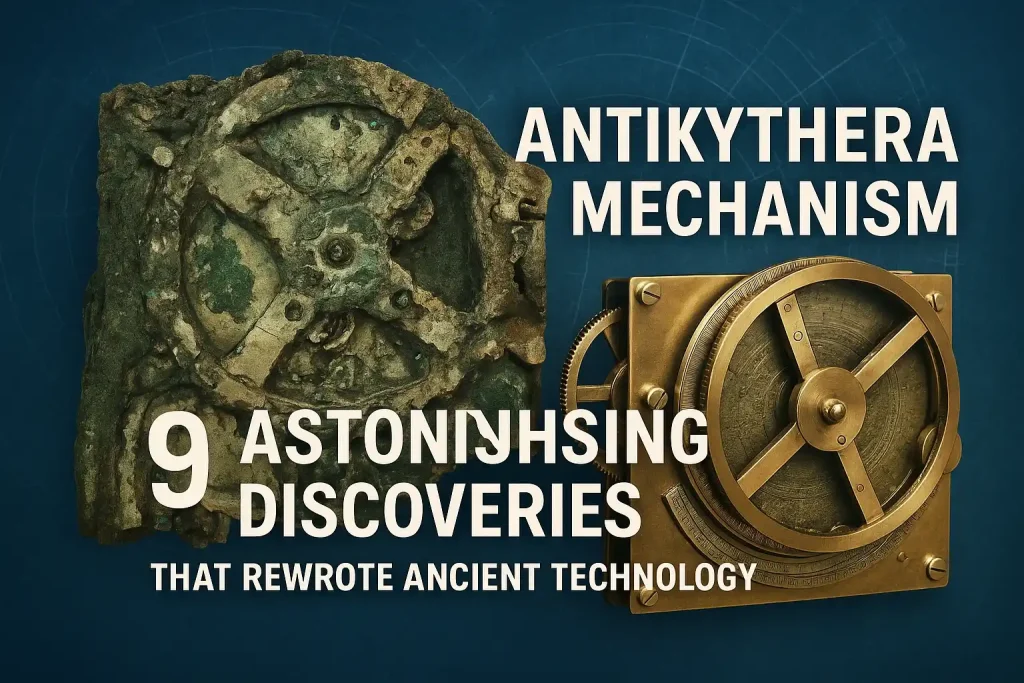
Antikythera Mechanism: 9 Astonishing Discoveries That Rewrote Ancient Technology
A deep dive into the engineering, astronomy, and historical implications of the world’s oldest known complex geared device.
Introduction — Why the Antikythera Mechanism Still Matters
The Antikythera Mechanism ranks among archaeology’s most dramatic revelations. Recovered from a 1st-century BCE shipwreck off the Greek island of Antikythera in 1901, this corroded cluster of bronze fragments sat in museum storage for decades before researchers realized it was far more than a curiosity. Advanced imaging and painstaking reconstruction have revealed a compact, precision-geared instrument capable of predicting eclipses, tracking lunar phases, and modeling complex astronomical cycles. The device challenges assumptions about the timeline of technological sophistication in the ancient Mediterranean and forces us to reassess the technical capabilities of Hellenistic craftsmen and astronomers.
In this article we present nine astonishing discoveries about the Antikythera Mechanism—findings that reshape our understanding of ancient engineering, astronomy, and cross-cultural knowledge transfer. Throughout, internal links will guide readers to related topics in our archives, including broader themes of ancient mysteries and the science of early technology.
1. The Antikythera Mechanism Is an Ancient Analog Computer
Perhaps the most consequential discovery is that the Antikythera Mechanism functions as an analog computer. Its complex network of interlocking bronze gears models astronomical phenomena: the synodic and sidereal months, the Metonic cycle (19-year lunar-solar cycle), and eclipse prediction through the Saros cycle. This wasn’t a decorative object or a simple calendar—it was a computational instrument.
Early X-ray imaging and later high-resolution CT scans demonstrated multiple gear trains and a differential-like arrangement enabling compound motion. The device uses gear ratios to transform constant input (a crank rotation) into varying outputs—hand positions, dial movements, and pointer speeds—effectively solving equations mechanically centuries before the mechanical clocks of medieval Europe.
2. Remarkable Precision and Miniaturized Engineering
The engineering precision evident in the Antikythera Mechanism astonished researchers. Individual gears contain carefully cut teeth with specific counts, producing mathematically exact ratios. The machining tolerances—by hand and with Hellenistic tools—demonstrate a level of miniaturization and metallurgical control usually associated with far later periods.
It’s now clear that ancient workshops could reliably produce finely meshing gears and axles, and that this knowledge was part of a practical engineering tradition. The quality suggests a specialized craft tradition—possibly itinerant groups of metalworkers and instrument-makers—transmitting techniques across Hellenistic centers like Rhodes, Athens, and Pergamon.
3. The Mechanism Predicted Eclipses — An Astronomical Calendar
One of the device’s principal functions was eclipse prediction. The front and back dials include inscriptions and markings related to the Saros (approximately 18 years 11 days) and Exeligmos cycles (three Saros cycles), allowing operators to forecast lunar and solar eclipses and mark their characteristics. The mechanism encoded the irregular motion of the Moon and its anomaly through complex gearing so that a single rotation of the input shaft advanced multiple dials with different periodicities.
This capability reveals not only mechanical skill but also deep astronomical knowledge: the ability to observe, tabulate, and abstract celestial periodicities and then realize them mechanically.
4. It Encoded Diverse Calendrical Systems
The Antikythera Mechanism simultaneously represented multiple calendars: the Metonic cycle (lunar-solar), the Saros eclipse cycle, and possibly the ancient Egyptian or Greek civil calendar correlations. Its inscriptions suggest instructions for reading the dials and converting between calendar systems—a key feature if it was used for civic, religious, or navigational planning.
Modern reconstructions show front-face rings for the zodiac and months, with subsidiary dials for lunar phases and eclipse tables on the back. This multi-calendar integration demonstrates that Hellenistic scholars were comfortable with cross-system conversions, and that instruments served as portable repositories of technical knowledge.
5. The Craftsmanship Points to Hellenistic Centers of Innovation
Where was the mechanism made? While the shipwreck’s findspot is off Antikythera, stylistic and epigraphic clues point toward production in Hellenistic Greek centers renowned for astronomical research—likely Rhodes or Corinth, possibly in collaboration with astronomers from Alexandria. Rhodes was a hub for sophisticated mechanical calendars and astronomical paraphernalia; the famed astronomer Hipparchus (2nd century BCE) and later scholars in Alexandria laid intellectual groundwork for such devices.
Evidence from inscriptions and the mechanical design connects the mechanism to a scholarly milieu that combined geometry, observational astronomy, and practical engineering—an environment ripe for creating such an instrument.
6. Advanced Gear Trains Reveal Deep Mathematical Knowledge
Detailed CT-based reconstructions uncovered gear trains realizing mathematically exact ratios—some requiring compound gear reductions and even a differential-like arrangement to model the Moon’s elliptical anomaly. The presence of these solutions suggests artisans were translating advanced mathematical tables into mechanical form.
This conversion from mathematical models to mechanical computation is profound: it indicates Hellenistic researchers recognized and used mathematical approximations in ways that could be operationalized—turning abstract numbers into a working, demonstrable instrument.
7. The Device Was Instructed for Use — Written Labels and User Guidance
One of the most humanizing discoveries was the dense set of inscriptions on surviving fragments—text that appears to be operator instructions: how to set the dials, what a given pointer indicates, and notes on eclipse types. The presence of textual guidance suggests the mechanism was intended for practical use by educated operators, not merely as a scholarly model.
Translations of the inscriptions reveal direct references to months, zodiacal signs, and eclipse conditions—an interface marrying engineering with pedagogy. This implies an audience: educated practitioners—astronomers, navigators, or civic officials—capable of reading and using the device.
8. The Antikythera Knowledge Tradition Was Broader Than Previously Thought
The existence of the mechanism implies a broader tradition of technical treatises, instrument design, and toolkit knowledge that has otherwise been lost or scattered. Literary references in classical texts allude to devices and automata, and archaeological finds of simpler geared instruments suggest the Antikythera Mechanism may be a surviving apex of a disappearing craft tradition.
Scholars argue that the mechanism’s complexity requires teaching, apprenticeship, and possibly institutional workshops—networks that transmitted technical recipes across regions and generations. The scarcity of surviving artifacts owes more to the vagaries of preservation than to the absence of tradition.
9. Modern Reconstructions Confirm Functionality and Inspire New Research
Reconstruction projects—combining 3D printing, bronze casting, and mechanical modeling—have reproduced working Antikythera Mechanism models that validate earlier hypotheses about gear counts and dial motion. These replicas show the device’s practical usability and allow researchers to experiment with reading conventions, astronomical inputs, and calibration methods.
Modern reconstructions have also sparked interdisciplinary collaboration among historians, materials scientists, astronomers, and engineers—demonstrating how a single artifact can catalyze multiple fields.
Implications for History of Science and Technology
The Antikythera Mechanism’s implications are profound. It forces a re-evaluation of the technological timeline: complex gear-based computation existed far earlier than previously acknowledged. While mechanical complexity reemerged in medieval and Renaissance Europe, the Antikythera shows that ancient Mediterranean cultures possessed both the intellectual frameworks and the craft techniques to create advanced mechanical analogs.
Moreover, the device illustrates that theoretical astronomy and practical instrument-making were deeply integrated in Hellenistic scientific culture. The boundary between abstract scholarship and hands-on engineering was porous; geometrical models informed devices, and constructed instruments fed back into observational practice.
Where to See the Antikythera Mechanism and Ongoing Research
The fragments of the original Antikythera Mechanism are housed at the National Archaeological Museum in Athens, where ongoing conservation and imaging have continued to reveal new inscriptions and structural details. International collaborations—most notably the Antikythera Mechanism Research Project—have combined CT scanning and epigraphic work to deepen understanding.
New discoveries continue: additional fragments recovered in later expeditions and improved imaging techniques have yielded more readable text and clarified mechanical linkages. Research remains active, meaning our picture of the mechanism can still evolve.
Related Mysteries and Comparative Instruments
The Antikythera Mechanism sits within a broader family of ancient technological puzzles. Comparative study of Hellenistic automata, water clocks, and armillary spheres reveals a world where mechanical representations of the cosmos were common intellectual tools. Readers may find further context in our related pieces on Mysteries & History and technology in antiquity.
Practical Lessons: What the Antikythera Mechanism Teaches Modern Makers
Several practical lessons emerge for contemporary technologists and historians alike:
- Integrate Theory and Practice: The mechanism demonstrates how computational ideas can become practical tools; modern designers can benefit from this marriage of modeling and fabrication.
- Value Craft and Iteration: Precision handcraft and iterative refinement produced durable results. Patience, prototyping, and empirical testing remain core engineering virtues.
- Preserve and Share Knowledge: The device underscores how fragile technical traditions can be; proactive documentation and open collaboration help prevent future losses of expertise.
Conclusion — A Device That Keeps Rewriting the Past
The Antikythera Mechanism is more than an ancient curiosity; it is living evidence that Hellenistic engineers and astronomers achieved computational and mechanical feats that would not be widely paralleled for a millennium. Each new scan, transcription, and reconstruction deepens our appreciation of their ingenuity and forces historians to redraw lines in the narrative of technological progress.
From gear teeth cut by hand to inscriptions that teach operators how to read the dials, the mechanism blends craftsmanship, education, and science. It reminds us that human cultures have long found imaginative ways to compute, predict, and represent the world—and that many of those traditions await rediscovery.
For readers inspired to learn more, explore our Articles Hub, the Mysteries & History archive, and authoritative external resources listed below.