
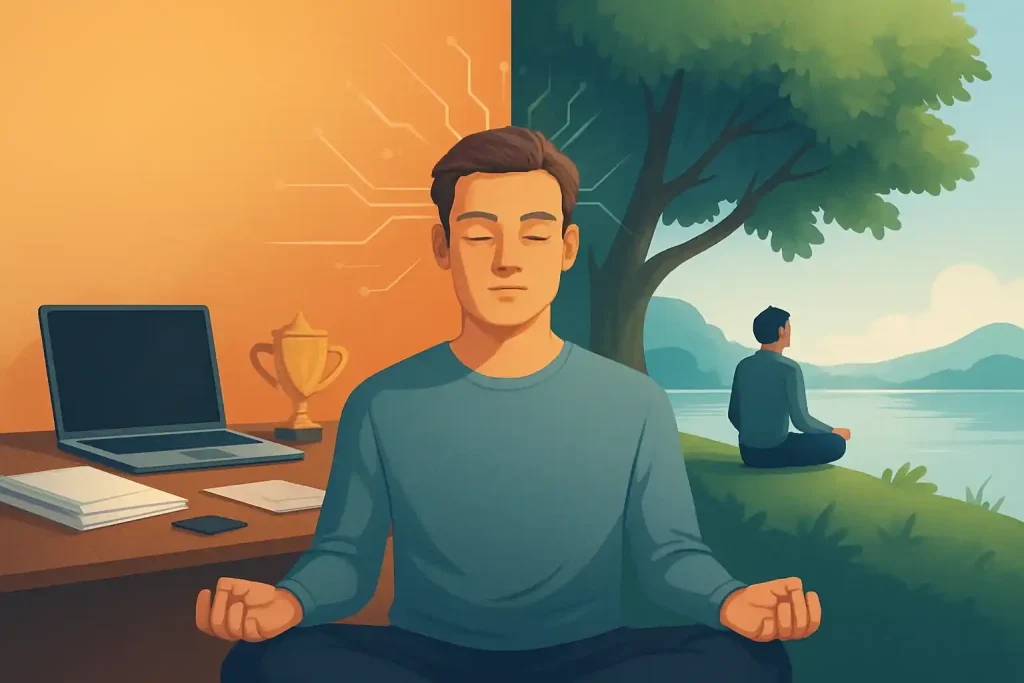
Balancing Ambition and Inner Peace: The Modern Quest for Fulfillment
Introduction
In today’s high-speed world, finding Inner Peace has become just as essential as achieving success, ambition is often celebrated as the ultimate virtue — the driving force behind innovation, progress, and success. We are told to dream bigger, achieve more, and constantly push beyond our limits. Yet, beneath the surface of this ceaseless striving lies a quiet truth: the harder we chase success, the further we may drift from inner peace. The challenge of our time is not merely how to achieve more, but how to do so without losing ourselves in the process. While ambition drives us forward, Inner Peace keeps us grounded.
Modern society thrives on acceleration — endless notifications, tight deadlines, and the subtle pressure to keep proving our worth. While ambition fuels personal and professional growth, it also creates an internal tension between drive and stillness. The human mind, wired for survival and comparison, can easily become trapped in cycles of anxiety, self-doubt, and burnout. What once began as healthy motivation can evolve into exhaustion and emotional emptiness. This is where the art of balance becomes essential — learning to pursue success without letting it consume our peace.
Psychological research increasingly supports this idea. Studies published by the Harvard Business Review and the American Psychological Association reveal that chronic stress from overachievement weakens creativity, empathy, and decision-making. In contrast, those who intentionally cultivate mindfulness and emotional regulation report higher satisfaction, stronger relationships, and sustained productivity over time. True fulfillment, then, may not come from endless striving, but from harmonizing ambition with calm awareness.
This concept resonates deeply with the philosophy of mindful living, explored in our earlier article Mindful Living: The Science and Daily Practices for a Balanced Life. Inner peace is not the absence of goals but the presence of clarity — the ability to act with purpose while remaining centered. It’s about realizing that success and serenity are not opposing forces but two sides of the same journey.
As we explore this balance between ambition and inner peace, we’ll uncover not just psychological insights but also practical ways to realign with what truly matters — to achieve, yes, but also to be.
The Dual Nature of Modern Success
Success in the modern world is both a source of empowerment and exhaustion. On one hand, ambition drives creativity, resilience, and progress — it’s the spark that propels people to build, innovate, and evolve. On the other, it can quietly morph into an unending pursuit that leaves little room for reflection or rest. The paradox of modern achievement is that the very mindset that fuels success often prevents us from fully enjoying it.
The Cost of Constant Achievement
From early education to corporate culture, we’re conditioned to equate doing more with being more. Our calendars overflow, our inboxes never rest, and our self-worth becomes intertwined with our productivity. While this drive can lead to material rewards, the emotional cost is often hidden: anxiety, burnout, and an ever-growing sense of inadequacy.
According to a report from the World Health Organization, chronic workplace stress has become a global epidemic, contributing to rising cases of depression and fatigue. Neuroscientific research also shows that continuous exposure to high-pressure environments floods the brain with cortisol — a stress hormone that suppresses creativity, emotional regulation, and long-term motivation.
The pursuit of success, when detached from balance, turns into a treadmill: the faster we run, the less ground we actually cover. This endless race leaves little space for introspection, gratitude, or connection — the very elements that give meaning to success in the first place.
The Inner Void Behind Outer Success
Modern psychology often describes this phenomenon as achievement addiction. Individuals may hit every external milestone — promotions, recognition, financial stability — yet still feel an inner void. Why? Because external success rarely satisfies the deeper human need for meaning, peace, and authentic connection.
In one of the most cited studies by the Journal of Positive Psychology, researchers found that people who defined success primarily through external metrics (money, status, approval) reported significantly lower life satisfaction than those who prioritized purpose and personal growth.
This “void of fulfillment” reveals the duality of ambition: it’s both a gift and a trap. When guided by awareness, ambition leads to creation and contribution. When fueled by fear or comparison, it spirals into self-judgment and emotional exhaustion.
True success, therefore, is not about suppressing ambition but integrating it — aligning it with one’s values and inner calm. As we’ll explore in the next section, understanding the essence of inner peace is the first step toward redefining what success truly means.
Understanding Inner Peace in a Modern Context
In a world that thrives on noise, speed, and endless comparison, the idea of inner peace can feel almost mythical — a poetic ideal rather than a reachable state. Yet, neuroscience, psychology, and even ancient philosophy agree on one point: inner peace is not the absence of chaos, but the ability to remain centered within it.
The Psychology of Inner Calm
From a psychological perspective, inner peace is a state of emotional equilibrium — a condition in which thoughts, emotions, and physical sensations are aligned rather than in conflict. According to research from the American Psychological Association, individuals who cultivate practices of self-awareness and mindfulness demonstrate lower levels of cortisol, improved decision-making, and greater emotional resilience.
This inner calm doesn’t come from external achievements or ideal life conditions. It emerges from how the mind interprets and responds to experiences. In other words, peace is not something we “find” in the world; it’s something we build within.
The human brain’s default mode network (DMN) — active during moments of self-reflection — plays a crucial role here. Studies show that overactivity in the DMN is linked with rumination, anxiety, and emotional instability. Mindfulness and contemplative practices, on the other hand, reduce this overactivity, helping individuals shift from self-centered worry to present-moment awareness.
This scientific insight mirrors what ancient wisdom traditions have taught for centuries: peace begins where attachment and overidentification end.
The Philosophical Dimension: Stillness Amid Movement
Philosophers from different eras — from Stoics like Epictetus to Eastern sages like Lao Tzu — viewed inner peace as the art of non-reactivity. Stoicism teaches that while we can’t control external events, we can always choose our attitude toward them. Lao Tzu’s Tao Te Ching echoes this truth: “When there is no desire, all things are at peace.”
In modern terms, this doesn’t mean detachment from life, but rather engaged stillness — a state in which one participates fully in the world without being consumed by it. This kind of peace is dynamic, not passive. It allows us to move through challenges with awareness instead of resistance.
When ambition, success, and uncertainty collide (as they often do in modern life), cultivating this form of inner stillness becomes essential. Without it, the mind constantly oscillates between the past and the future — what psychologists call “time anxiety.” With it, we reclaim our capacity to live intentionally and gracefully, even amid chaos.
The Science of Presence
One of the most profound findings in modern neuroscience is the plasticity of the brain — its ability to rewire itself through conscious practice. This means that inner peace is not a personality trait; it’s a skill that can be developed.
Regular practices such as deep breathing, mindful journaling, and short daily meditations can gradually reshape neural pathways, strengthening regions like the prefrontal cortex (responsible for focus and regulation) while calming the amygdala (the brain’s fear center).
In a 2018 study by Harvard researchers published in Frontiers in Human Neuroscience, participants who engaged in mindfulness training for just eight weeks showed measurable increases in gray matter density associated with emotional regulation and empathy.
The message is clear: the more we train our awareness, the more peace becomes our default state — not an occasional escape.
A Modern Reinterpretation
Inner peace in the 21st century isn’t about escaping technology or renouncing ambition. It’s about learning to navigate them consciously. It’s the quiet strength that allows one to meet deadlines without losing presence, to pursue goals without attachment to outcomes, and to connect deeply without being drained by constant comparison.
True peace, then, is integration: a harmony between ambition and surrender, doing and being, progress and presence. It doesn’t ask us to slow the world down — it invites us to move through it differently.
As the philosopher Alan Watts once said, “You can’t stop the waves, but you can learn to surf.” Inner peace is precisely that — not a still lake, but the graceful art of balance amid the waves.
The Conflict Between Drive and Stillness
Modern culture glorifies ambition — the constant striving for more. We are taught to set goals, push limits, and measure our worth by productivity. Yet, the very drive that fuels progress often becomes the same force that erodes inner peace. The paradox of our time is this: the harder we chase fulfillment, the further it seems to drift away. When ambition overshadows Inner Peace, stress becomes the silent cost of achievement.
Ambition as a Double-Edged Sword
Ambition, in its purest form, is a creative impulse — the inner fire that motivates us to grow, build, and evolve. Psychologically, it activates the brain’s reward system, releasing dopamine that fuels focus and persistence. But when ambition becomes excessive or ego-driven, it begins to trigger chronic stress responses, leading to burnout, anxiety, and emotional disconnection.
According to a study published by the American Institute of Stress, over 77% of professionals report experiencing physical symptoms of stress directly tied to performance pressure. What was once a healthy desire for achievement transforms into a cycle of constant striving — the feeling that no accomplishment is ever enough.
This imbalance creates what psychologist Dr. Scott Barry Kaufman calls the “achievement trap”: when one’s identity becomes so intertwined with doing that simply being feels uncomfortable or unproductive.
The Nature of Stillness
Stillness is often misunderstood as inaction or passivity. In reality, it is the capacity to remain present and grounded even amidst activity. The human nervous system thrives when it oscillates naturally between activation and rest — between drive and stillness. But in the modern world, this rhythm is disrupted. Constant notifications, social media metrics, and competitive environments keep the sympathetic nervous system (the body’s fight-or-flight response) perpetually active.
Neuroscientist Dr. Andrew Huberman explains that intentional stillness — such as slow breathing, open-focus meditation, or mindful walking — reactivates the parasympathetic system, which allows recovery and creative insight to emerge. Without it, our drive becomes blind momentum, disconnected from clarity or meaning.
Ancient wisdom also echoes this truth. The Taoist principle of Wu Wei (literally “non-forcing”) teaches that the most effective action flows from stillness — a state of inner alignment rather than struggle. In the words of Lao Tzu: “By letting go, it all gets done.”
This doesn’t mean giving up ambition; it means allowing ambition to be guided by awareness rather than restlessness.
When Drive and Stillness Collide
The conflict between drive and stillness is not external — it happens within the mind. One part seeks control, progress, and validation; another longs for surrender, peace, and presence. The tension between these forces is what psychologist Carl Jung referred to as the conflict of opposites — a necessary friction for inner growth.
Jung believed that integration, not suppression, is the key. When we acknowledge both forces — our desire to achieve and our need to rest — they stop competing and begin collaborating. The result is what modern psychology calls harmonious ambition — the ability to pursue meaningful goals without losing emotional equilibrium.
In this balanced state, drive becomes purpose, and stillness becomes strength. We move with intention rather than compulsion. We act not from scarcity, but from wholeness.
From Striving to Flow
Psychologist Mihaly Csikszentmihalyi’s concept of flow provides a modern synthesis of this balance. Flow is a state in which high engagement meets deep calm — when one is fully immersed in an activity yet free from self-conscious striving. In flow, time feels suspended, effort becomes ease, and creativity flourishes.
The secret to flow, according to research, lies in alternating periods of focus and recovery. Just as athletes need rest to rebuild muscle, the mind needs stillness to sustain performance. This rhythm — expansion followed by contraction — mirrors nature’s cycles: day and night, tides and calm, breath in and out.
When ambition and stillness learn to coexist, life becomes less of a race and more of a rhythm. Instead of chasing meaning, we embody it.
Practical Strategies for Balancing Ambition and Serenity
Striking the right balance between ambition and serenity isn’t about slowing down your dreams — it’s about aligning them with a sense of peace that sustains you over time. Modern life constantly pushes us to “do more,” but without mindful balance, ambition easily becomes anxiety. The following practical strategies can help you pursue goals without losing your calm center.
1. Set Conscious Boundaries Between Work and Rest
In a culture that glorifies hustle, boundaries act as your shield. Designate clear start and end times for your workday and respect them as you would a professional meeting. Research from the Harvard Business Review emphasizes that individuals who intentionally separate professional and personal time report higher satisfaction and lower burnout levels (Harvard Business Review).
A simple yet effective practice is to create a “digital sunset” — a time in the evening when you disconnect from screens and shift into relaxation mode. Use this transition to engage in quiet reflection, reading, or gentle stretches. Over time, this ritual teaches your nervous system that it’s safe to rest, even amid ambition.
2. Mindful Routines for Cultivating Inner Peace Daily
Mindfulness isn’t about renouncing ambition; it’s about making your goals meaningful. Instead of chasing endless checklists, define why a goal matters to you. Is it rooted in your values or external pressure?
Use frameworks like the SMART method (Specific, Measurable, Achievable, Relevant, Time-bound), but combine it with reflection: “Will achieving this contribute to my well-being?” This question reframes productivity as a holistic pursuit.
For example, rather than setting “earn a promotion,” you might write “grow in my role while maintaining emotional health, Small, consistent habits such as mindful breathing, gratitude journaling, and short breaks restore Inner Peace throughout a busy day.”
You can also explore mindfulness exercises shared in Mindful.org to stay anchored in intention rather than stress.
3. Schedule Moments of Stillness
Stillness is not wasted time — it’s the reset button for clarity. Neuroscience research from Stanford University shows that moments of quiet reflection activate the brain’s default mode network, fostering creativity and problem-solving.
Integrate stillness intentionally:
- Morning silence: Start your day with 5–10 minutes of breathing before checking messages.
- Mindful breaks: Every 90 minutes, pause, stretch, and notice your surroundings.
- Evening grounding: Reflect on one thing you’re grateful for — it strengthens emotional resilience.
These pauses don’t diminish ambition; they refine it, keeping your focus aligned and your energy sustainable.
4. Redefine Productivity and Success
True productivity isn’t about constant output; it’s about effective energy management. Working smarter means prioritizing what truly moves you forward. The Pareto Principle (80/20 rule) can guide you: 80% of results often come from 20% of focused effort.
Ask yourself regularly:
“Am I busy, or am I being effective?”
This subtle shift prevents burnout and keeps you engaged with work that has purpose.
On your own website, readers can explore related insights in The Psychology of Decision Fatigue: Why We Get Tired of Choosing — an internal link that complements this section by showing how decision overload affects motivation.
5. Create Rituals of Renewal
Just as you plan work projects, plan rest with equal intention. Regular renewal rituals — a mindful walk, digital detox weekend, or creative hobby — reinforce balance.
According to the American Psychological Association, consistent restorative habits enhance focus and emotional regulation, key ingredients for long-term success. The secret lies not in massive changes but in consistent, nourishing routines that honor both sides of your nature — the achiever and the dreamer.
Balancing ambition and serenity requires daily awareness, gentle discipline, and compassion for your limits. When you start living with both drive and stillness, your goals stop draining you — they start expanding you.
The Fulfillment Equation: Redefining Success
In a world that constantly measures success through productivity, wealth, or recognition, the concept of fulfillment often gets overshadowed. Yet, the deeper True success blends achievement with Inner Peace, creating a sense of fulfillment beyond external validation. The modern movement toward mindfulness and emotional intelligence has begun reshaping how people define what it means to “make it.” Fulfillment, unlike traditional success, isn’t about what you accumulate — it’s about how aligned you feel with your values, your growth, and your peace.
1. Success as Alignment, Not Comparison
For generations, people have been taught to chase metrics — promotions, possessions, popularity. But these external milestones often leave an inner void.
True fulfillment emerges when your ambitions align with your authentic self. This means pursuing goals that resonate with your purpose rather than societal expectations.
Psychologist Abraham Maslow, in his hierarchy of needs, described self-actualization as the pinnacle of human motivation — the drive to realize one’s fullest potential. But Maslow also emphasized that this pursuit must emerge from inner wholeness, not insecurity.
To realign, ask yourself:
“Would I still value this goal if no one else saw it?”
This question filters out ego-driven ambitions, allowing serenity to coexist with achievement.
For further reading, Psychology Today offers excellent insights into how identity and fulfillment intertwine.
2. Emotional Wealth Over Material Wealth
Money and status can provide comfort, but not necessarily happiness. Emotional wealth — resilience, gratitude, and connection — is a more reliable predictor of lasting satisfaction. A Harvard Study of Adult Development, one of the longest-running studies on happiness, found that meaningful relationships were the strongest indicator of well-being, far beyond income or fame (Harvard Gazette).
Practicing gratitude, empathy, and mindful presence builds emotional wealth that compounds over time. You might not always control circumstances, but you can control your emotional investments — what you focus on, nurture, and protect.
3. Redefining Achievement Through Presence
Ambitious people often equate achievement with forward motion. Yet fulfillment often arises in stillness — in the present moment where life actually happens.
This paradox is central to modern mindfulness teachings: you can achieve much, but if you never feel it fully, it’s as if it never occurred.
Integrate mindful presence into your success journey:
- When celebrating milestones, pause before moving to the next goal.
- During daily tasks, practice “single-tasking” — giving full attention to one thing at a time.
- Use reflection prompts like “What made me feel alive today?” instead of “What did I accomplish?”
These small shifts transform ordinary success into soulful fulfillment.
4. Purpose as the Missing Variable
The “fulfillment equation” can be thought of as:
Fulfillment = Achievement × Alignment × Purpose
Without purpose, ambition feels hollow. Purpose is not necessarily a grand mission; it can be found in small acts — teaching, creating, caring, learning. As Viktor Frankl observed in Man’s Search for Meaning, having a sense of purpose enables humans to endure and even grow through suffering.
Ask yourself:
“How does what I do add meaning to my life and to others?”
When ambition fuels purpose rather than ego, peace naturally follows.
For complementary reading, your site’s article Mindful Living: The Science and Daily Practices for a Balanced Life expands on how mindfulness deepens the sense of purpose in daily routines.
5. Success as a State, Not a Destination
Perhaps the most radical redefinition of success is viewing it not as a finish line, but a state of being.
Fulfillment is a continuous practice — a flow between striving and surrender, doing and being.
The new measure of success becomes:
- Peace instead of pressure
- Meaning instead of milestones
- Presence instead of perfection
When we see success this way, serenity is no longer the opposite of ambition — it’s its completion.
Conclusion
In the delicate dance between ambition and serenity, most of us spend years swinging from one extreme to the other — either chasing relentless progress or craving complete escape. Yet, the true art of fulfillment lies not in choosing one side but in learning how to let both coexist gracefully.
Ambition gives life direction; serenity gives it depth. When you merge them, you create a rhythm that feels both purposeful and peaceful, allowing you to grow without constant strain. This balance doesn’t mean eliminating drive or suppressing dreams. It means redefining what “thriving” really looks like — not as an endless climb, but as a mindful journey.
The modern world conditions us to equate success with acceleration: faster careers, higher goals, busier schedules. But sustainable success demands stillness — spaces where reflection, gratitude, and realignment can breathe. As neuroscientific research from Stanford University and Harvard Medical School has shown, mindfulness-based approaches don’t only reduce stress; they enhance focus, decision quality, and emotional intelligence (Harvard Health Publishing, Stanford Medicine). These findings reveal that serenity isn’t passive — it’s productive in a deeper, more holistic way.
When we talk about fulfillment, we’re talking about an inner equation that can’t be measured by money, metrics, or praise. It’s the balance between doing and being, where effort arises naturally from clarity instead of pressure. That’s why learning to pause — even briefly — becomes a form of intelligence. It’s how you prevent ambition from burning out and serenity from fading into complacency.
If ambition is fire, serenity is oxygen. One drives; the other sustains.
To live fully, you need both.
So, how can you start living this truth today?
- Take time each morning to ground your intentions before diving into tasks.
- Ask not only “What do I want to achieve?” but also “How do I want to feel while achieving it?”
- Protect your stillness as fiercely as your productivity.
In time, you’ll find that the peace you once thought came after success actually becomes the foundation of it.
For readers who wish to deepen their practice, your related article Mindful Living: The Science and Daily Practices for a Balanced Life provides practical guidance on mindfulness, while The Psychology of Decision Fatigue: Why We Get Tired of Choosing explores how mental overload disrupts both clarity and calm.
Ultimately, the highest form of success is serenity itself — not the absence of ambition, but the mastery of it. When your goals serve your growth, when your pace honors your peace, and when your achievements reflect your inner truth — that’s fulfillment. Not as a destination, but as a way of being. Balancing ambition and Inner Peace is not a destination but a lifelong practice — one that nurtures both purpose and serenity.”
References & Further Reading
- Harvard Health Publishing. (2023). Mindfulness meditation may ease anxiety, mental stress.
https://www.health.harvard.edu/mind-and-mood/mindfulness-meditation-may-ease-anxiety-mental-stress - Stanford Medicine. (2022). How mindfulness changes the brain and promotes resilience.
https://med.stanford.edu/mindfulness.html - Harvard Gazette. (2017). Over nearly 80 years, Harvard study has been showing how to live a healthy and happy life.
https://news.harvard.edu/gazette/story/2017/04/over-nearly-80-years-harvard-study-has-been-showing-how-to-live-a-healthy-and-happy-life/ - Psychology Today. (2024). What Is Fulfillment?
https://www.psychologytoday.com/us/basics/fulfillment - Mindful.org. (2024). How to Practice Mindfulness Throughout Your Day.
https://www.mindful.org/how-to-practice-mindfulness-throughout-your-day/ - American Psychological Association (APA). (2022). Recovering from work-related stress: The role of psychological detachment and recovery experiences.
https://www.apa.org/news/press/releases - Viktor E. Frankl. (2006). Man’s Search for Meaning. Beacon Press, Boston.
(Classic reference for purpose and fulfillment psychology.) - Harvard Business Review. (2023). The Case for Work-Life Boundaries.